

Introduction
I traveled to Türkiye, to deliver a keynote and workshop at the II. English Language Teachers’ Conference: Innovation and Technology in English Language Education in Bursa. The event was hosted by The British Council, the Directorate General for Innovation and Educational Technologies (YEĞİTEK) of the Ministry of National Education, and the Sabancı Foundation.
English language teachers from all over the country were invited to apply to attend the conference and 300 teachers travelled to Bursa to attend a packed two-day event on 23rd and 24th September.
Conversation around AI echoed throughout the conference and I heard many inspiring and inspired stories from teachers on how they used AI in the practice, with their students or what they thought about this exponential epistemic technology.
Teachers sharing their experience, practice and the use of AI in series of workshops throughout the event made the conference extra special. The teacher voice took centre stage.
On day two I ran a workshop for 50 teachers: “The Year is 2035. What went wrong?”
The discussion
The teachers spilled into the room, and sat grouped around tables. I noticed their intrigued curiosity and uncertainty about what to expect.
I explained the approach for the workshop and what I wanted them to do. I opted for a pre-mortem with a difference and asked the teachers to imagine the year 2035 and what they thought the role of AI might be in the future classroom. More to the point, I threw them a gauntlet and wanted to start from the premise of “The Year is 2035. What went wrong?” Rather than an extrapolation of today’s practice and how AI could slot into that, I asked them to imagine what things could look like in 2035 with an AI actor in the midst of learners and teachers and to consider what would have gone wrong.
The challenge may seem straightforward; it isn’t. This is a difficult question, especially for education. After all, education tends to be quite static and is subject to the demands of stability and safety and the needs of elaborate education systems. The rapid evolution of digital technologies, and in particular, the rampant rise of GenAI, prove somewhat alien to these systems. And what they mean for the future of education and learning proves quite hard to fathom.
Imagination was central to the challenge in considering a future with AI where things went wrong. The groups were also asked to consider why they went wrong, what risks emerged and how they could be mitigated. Rather than leaving it at that and solely focusing on what went wrong, a positive note was introduced to the challenge. If things went wrong, what opportunities does that create? Needless to say, this really set the room alight and the positivity of the challenge resulted in debate, disagreement, agreement and the identification of some milestones to realise the opportunity between now and 2035.
Twelve groups were formed and each received an A3 poster with an outline, to aid travelling through the challenge and capture thinking, discussion and ideas. I requested “a loud classroom”. I didn’t need to ask them twice. The discussion ignited instantly, flaring into a highly collaborative example of teachers tackling a challenge together and reporting back to the room.
What emerged?
At a glance
Most groups shared a common fear of the loss of human capacities. This would considerably exceed any failure of AI technologies. Declining critical thinking and creativity appeared on almost every poster, closely followed by weaker relationships, empathy and communication.
The diagnosis was consistent: over-reliance, uncritical trust and an absence of scaffolded guidance. One group put it most sharply: “We confused fluent output with learning.”
Solutions clustered around four ideas. They included AI literacy, starting with teachers; clear policy with defined limits on AI use and context for use; a call for assessment that values process and live interaction; and, most important of all, the deliberate protection of in-person contact.
What did go wrong?
The imagined failures fall into five groups, with erosion of thinking and creativity being by far the most common.
Thinking and creativity
Nearly every poster recorded a decline in critical thinking, creativity or both. Groups wrote that “creativity is poisoned”; that people have started “imitating AI like parrots and don’t act like real humans”; and that students can no longer produce anything on their own.
Others described significant loss of curiosity “because everything is accessible any time”. They highlighted difficulty in independent decision-making, the demise of reading habits, shorter attention spans and the loss of handwriting skills. Laziness, addiction and lost productivity were named too, as was the inability to improve oneself without reliance on or critique by AI.
Relationships and emotions
Classrooms were imagined that ignored emotions and where empathy had faded. Some groups listed weaker social skills, less communication and collaboration, loneliness, and students losing the willingness to socialise. One group mourned the loss of authentic communication and of the empathetic bond between teacher and student.
The teacher’s role
Several posters described a diminishing or displaced role of the teacher: “AI replaced teachers” and “the teacher became a human generate button”. One group even warned that “teachers would only be present for a privileged minority”. Another noted that students lost respect for the teacher as a source of knowledge, because information is available everywhere.
Trust, ethics and fairness
Concerns were raised about AI producing false information and about AI resulting in unethical use, loss of privacy and identity, inequality in education, lost jobs and an erosion of critical AI literacy. One poster noted simply that the “assessment mindset has shifted”, i.e. eroded and no longer relevant. One group feared that the “purpose and need for learning is lost”.
Beyond the classroom
A few groups looked beyond the direct impact on teaching and learning. They cited sustainability (”we ran out of water”), health problems from sitting too much, and growing impatience as AI consumption increased significantly. One group recorded the disappearance of printed resources in favour of digital resources.
Two terms emerged in the room
One group came up with two key descriptions for AI failure: “ghost learning” in which learners and teachers would be overpowered by AI and become ghosts in learning, and “model collapse” highlighting stereotyping as a trigger for single approaches to education, that disregard models respecting context and humans in the classroom, in favour of AI.
Why it went wrong, and a rethink
The room largely blamed how AI would be used rather than AI itself. “We trusted it completely,” reported one group. Another group stated that people would see AI “as a deciding agent, not an assistant”. A third group highlighted that “we were so excited about using AI in every aspect of our life, so we overused it”.
Two further causes recurred. The first was a lack of control and clear guidelines at a time of rapid change; one group’s advice was simply to “calm down”. The second was human passivity: “AI became too intelligent; humans became too passive.” Learning lost its productive difficulty: “No struggle, no mistakes, no negotiation.”
The rethinking pointed in three directions.
Put people first
Technology should be the facilitator, with emotions and relationships taken into account. One group identified that AI has no eye contact and cannot empathise with students. Another proposed rethinking language as “a human connection tool” and co-creation with learners, with a focus on “emergent” learning resulting from and equally driving co-creation.
Set limits and teach the skills
Proposals included limiting use, especially for teenagers, and writing guidelines on how and when students use AI. One group wanted teachers to become experts in AI, backed by laws, policies and rules. Others wanted a set of “nevers”, a mandatory AI literacy course at every level, and government regulation that gives AI “a concrete role”.
Change assessment
One group of teachers proposed creative end-of-term projects judged by detailed descriptors rather than grades, with compulsory in-person group projects each month. They saw the human teacher as the most reliable evaluator, flagging AI bias as an open question. Another reframed how we should consider error: making mistakes “is an opportunity to grow”.
Emerging from what went wrong
Groups found real opportunities in the imagined failure, though not all of them are human-centric.
Time
If AI takes on the heavy lifting, students would get more time for social development and teachers would gain time for their own wellbeing. One group imagined students spending more time outdoors and in gyms.
Others valued immediate feedback and the ease of organising ideas.
One poster summed it up as “more time to do other things”.
Learning that fits the learner
One group imagined a boom in listening habits and improved critical thinking. Personalised, self-directed and flipped learning were prominent in the posters. This was accompanied by learners gaining more independence and developing agency.
The opportunity for a more inclusive education also resonated.
An interesting and beautiful opportunity emerged from one group. They hoped that learning would be “focused on desire”, with less weight on exams and a chance to “rediscover meaning”.
A stronger role for teachers
Groups saw teachers as “designers”, focusing on consistently high-quality teaching, responsive differentiation and greater psychological safety in class.
Checking AI’s misinformation was itself seen as a way to build students’ AI literacy.
Others saw an opportunity for students to be trained to create with AI’s help, not to have AI do the work for them.
Widening horizons
Posters mentioned collaboration with people around the world, quick translation, curiosity about other languages and cultures, new university fields and new jobs.
Psychological support was identified as a need as well as opportunity, especially in the ongoing interaction with the agents or tools.
Some looked further afield, to medical research, new technology for finding water and greater awareness of the need for the protection of nature.
Learning from failure
Taking risks and making mistakes were highlighted as gains and opportunities. Interesting failure could become a wake-up call: “When we notice we started to forget writing we will then know that we started to forget thinking.”
Despite seeing opportunity, not all of the entries proved that hopeful and some might have sat better under the what went wrong. Some groups answered with irony (”ignorance is bliss”, “we will be actors of a Black Mirror movie”, the movie that doesn’t reflect our image so that we can learn from it and gives us feedback, but that absorbs light and us). Others listed gains that sit uneasily beside the losses they had just named, such as more individual learning in a world already short of human contact.
Milestones
The milestones fall under four themes; only four carried a date, running from 2026 to 2030. We didn’t quite reach 2035 with the milestones...

Policy and regulation
A global policy for AI use; a national AI policy; international cooperation on government support and regulation; a human-centric AI framework; filters and restricted areas of use for students
National policy by the end of 2029
Pedagogy and assessment
A paradigm shift in teaching, learning and assessment towards a hybrid approach; assessment based on live interaction and process; thinking first and using AI to check at the end; leaving reflection to humans; valuing simple, effective work over polished output; revised curricula with more social interaction among students
Pedagogical use of AI by 2028
Human connection and wellbeing
AI and human collaboration; learner agency and community building; more in-person meetings; human-only creativity “Olympics”; a handbook on the psychological effects of AI; regular reflection, feedback and evaluation; new job fields; a reminder of “human power”; a balance between tradition and innovation
AI and human collaboration by 2030
A Strategic Roadmap for Change
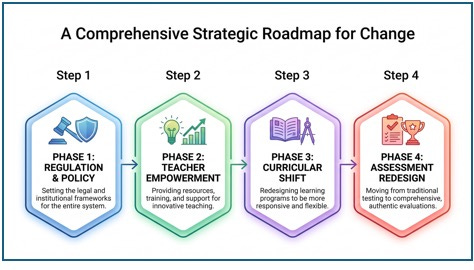
One group identified milestones sequenced as a chain: global policy, then teacher training, then transfer to students, then evaluation of the whole process. This led to identifying a strategic roadmap.
Tensions and open questions
Read together, the posters differ on four points. The discussion made room for these differences of opinion and did not set out to settle them.
Restrict or educate?
Some teachers wanted to set limits, filters and time restrictions on AI use. Others argued for AI literacy and guided use. Most wanted both.
Does AI close or widen the gap?
One discussion held that inequality could be solved by giving every student access to AI. Another imagined human teachers becoming a privilege of the few.
Independence or isolation?
Self-directed and individual learning appeared as an opportunity on many posters. Isolation and weak relationships appeared as a failure on almost as many.
One group even named homeschooling as the new trend.
Who acts first?
Proposals ranged from the individual teacher as a role model to national ministries and international cooperation. Few of the posters identified who should own each milestone.
That will be for another workshop…
Takeaways
Throwing a gauntlet to a group of passionate teachers results in lively debate and agreeable disagreement. The room was buzzing as teachers were allowed to imagine and consider that the destiny of teaching could be in an AI classroom.
What stood out even more is that the question of AI in the classroom is getting considered attention. Teachers are engaging with the challenges and opportunities with awareness and consideration for the learners and what AI means for wellbeing and human thriving.
What stood out even more, that this question on AI cannot be resolved in one workshop and that it will keep evolving itself, and that there are no definitive answers as the complexities of its rapid evolution only raised new questions that become the more artful to ask.
__________
The writing is my own and reflects a workshop. Editorial and Image Generation with the help of Claude and Gemini