

Introduction
Education is too often perceived through narrow frames: schools, universities, and formal qualifications. Yet, learning happens everywhere. Historically, research, policy, practice, educational technology (EdTech), and Artificial Intelligence (AI) have evolved in isolation, rarely engaging in genuine conversation with one another and frequently overlooking the most critical variable of all: learner engagement.
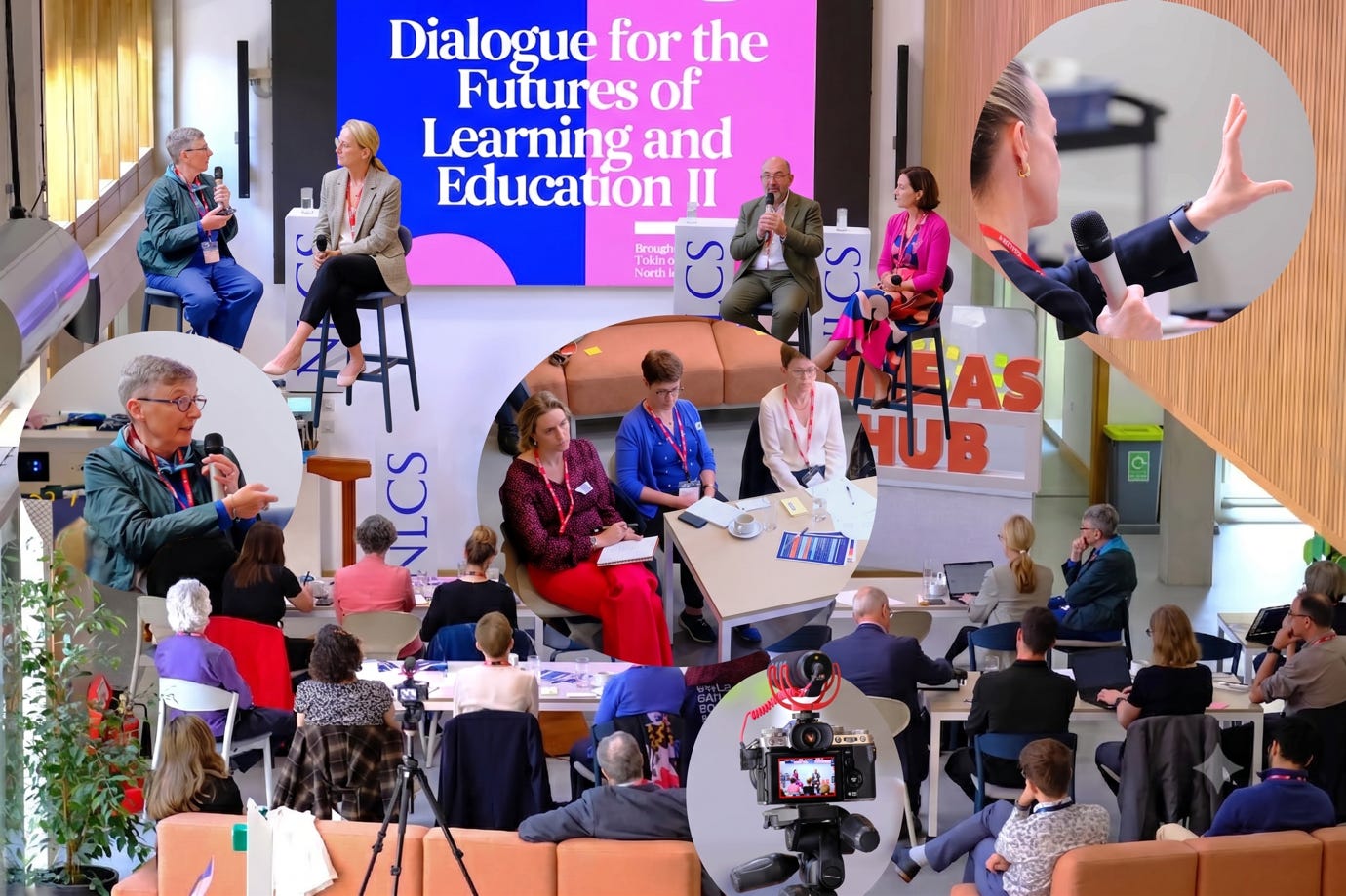
On June 2nd, the second Dialogue for the Futures of Education and Learning event convened at the North London Collegiate School. This invite-only gathering and series of events, engages in interdisciplinary reflection and dialogue aimed to challenge the boundaries of our current educational models.
The rationale behind the dialogue stems from an uncomfortable truth: today’s students are being prepared for a world that resists certainty and prediction, yet our existing systems persist in prioritising measurement over curiosity, benchmarking over aspiration, and standardization over the individual. Students are trained to meet standardised high stakes test or exam requirements to demonstrate their knowledge acquisition achievements, rather than being given the freedom and space to develop their intrinsic curiosity and become the self-regulating and autonomous agents of their learning and well-being, supporting them on their life-wide learning journeys and their future.
This discussion paper synthesises the interdisciplinary reflections and dialogues from the event. By exploring alternative behavioural frameworks, evaluating the socio-economic vulnerabilities of disengaged youth, scrutinising the global impact of AI, and re-centering the human teacher-student relationship, this paper outlines a new educational paradigm: The Explorer Learner.
Jour de Vent (Windy Day)
“Wind carries away destinies”, the synopsis of an award-winning short animation film created by a team of graduate students from l’École des Nouvelles Images in Avignon (France). Jour de Vent, the surprise introduction to the day set the tone and revealed the essence of the day. Exploration for creation, a process of curiosity and uncertainty, of collaborative shaping and realisation.
The dialogue proceeded in fireside chats, presentations and round table discussions, summarised in the discussion below.
Keynotes & Fireside Chats
The Disengaged Teen
A Fireside Chat with Jenny Anderson
In the Disengaged Teen: Helping Kids Learn Better, Feel Better and Live Better, co-authors Jenny Anderson and Dr Rebecca Winthrop consider how anxious and disengaged teens can be supported to encourage their academic and emotional flourishing.
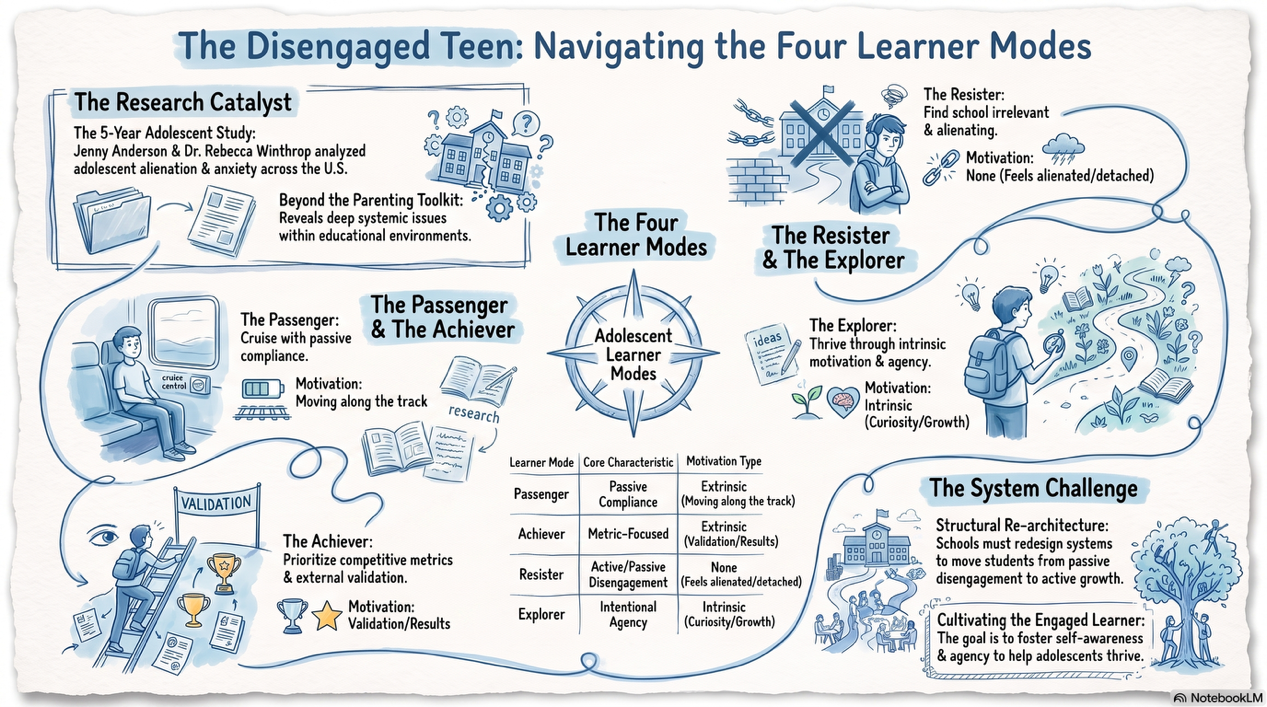
Initially devised as a toolkit for parents, this book goes well beyond the realm of parenting. The work results from a five-year research endeavour by the authors in the US, engaging with adolescent learners across the country. Realising many learners were disengaged and felt alienated towards education, the authors also focused on real-time stories of adolescents and their relationship to learning, including those who embraced a new connection to learning. This led to identifying four modes of learning, used to navigate the demands of school and social dynamics that shaped internal engagement with learning and their own development.
The Disengaged Teen: Research, Learning Modes and System Challenge
In a fireside chat with Jenny Anderson, we unpacked the four learner modes observed in today’s teens and what they mean for their engagement with school, awareness of potential and wellbeing. The four modes highlight distinct behaviours and attitudes to learning and school.
The Passenger: Operates passively within the system, complying with directives and moving along the track. They appear to be in cruising mode but lack personal investment or intrinsic motivation.
The Achiever: Maximises performance and tends to be highly competitive but needs a sense of structured metrics. Learners in Achiever mode prioritise test milestones, results and validation over deep intellectual curiosity.
The Resister: Disengages actively or passively. They find the content and objectives of school often alienating, lacking in relevance and too detached from their lives and identity.
The Explorer Learner: Fares best. They learn better, are more adaptable, and nurture their well-being by leveraging intrinsic motivation and acting as an intentional agent of growth in open-ended environments. They are curious problem solvers and tend to like a challenge.
Listening to adolescents’ stories, identifying these four learner modes, the authors reached the conclusion that parents may benefit from a new toolkit to engage with their teen children. However, schools (and this applies to education systems too) have a distinct role to play in pursuing a structural re-architecture to engage learners, taking them out of passive disengagement to purposefully cultivate the engaged learner who has agency and self-awareness, helping them to thrive.
Breaking the NEET Cycle: Structural Vulnerabilities and Government Accountability
Vicky Bingham in a Fireside Chat with Jim Knight
(Rt Hon. Lord Knight of Weymouth)
The UK government published the Young people and work: Diagnostic report compiled by Alan Milburn on 28th May, a week prior to the dialogue event.
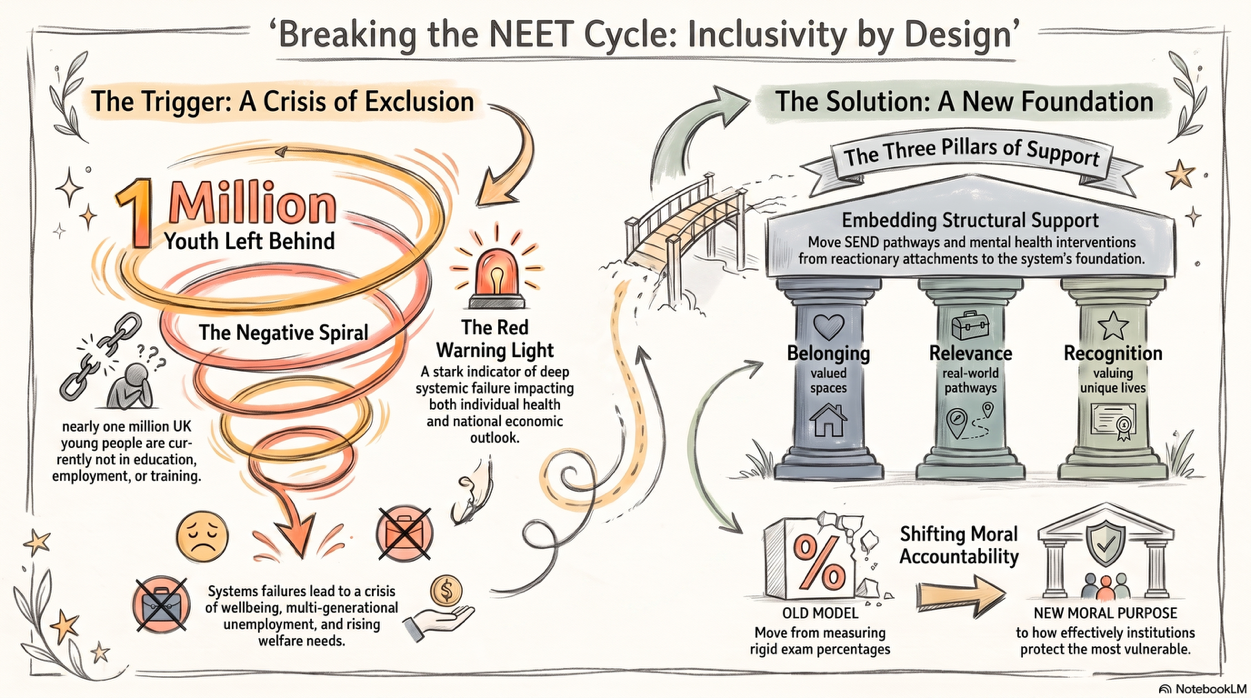
This report, a stark read, focuses on young people referred to in the UK as NEETs[1]. Nearly one million young people in the UK are not in employment, nor doing any learning and are increasingly being left behind, ignored by society and suffering from low esteem, health issues and lack of wellbeing. Caught in a negative spiral, they struggle to escape. They often come from multi-generational families where the same predicament has persisted across generations.
This not only represents a wellbeing and health crisis for those affected; it also increasingly impacts on the UK’s economic outlook as needs for welfare assistance are on the rise. A red warning light.
The report argues these people fall through the cracks due to deep systems failures. It proposes an urgent approach to address the needs of these people and provide them with meaningful opportunity.
The fireside chat revealed three core (and urgent) requirements highlighted in the report:
Belonging: Educational and corporate spaces need to be developed where youth struggling with mental health or neurodivergence feel secure and valued.
Relevance: An urgent move away from curricula that are strictly built to pass exams should be explored. Too often these cause many young learners to disengage when they lack practical real-world meaning and are solely focused on the needs of assessment and tests. This is exacerbated by the lack of apprenticeships and focus in school and education institutions on work placements and work experience.
Recognition: The lack of recognition of young people as individuals with unique skills, aptitudes and abilities has been overshadowed by the anonymous statistics, data points and league tables that ignore the lives and young people behind them.
Jim Knight argued that we need to consider Inclusivity by Design, embedding SEND or Neurodiversity pathways and mental health interventions into the foundation of the education system from day one rather than treating them as reactionary attachments.
Furthermore, system accountability should shift entirely from the exam percentages to accountable measuring of how effectively institutions support, protect, and develop pathways for the most vulnerable young people.
Breaking the NEET Cycle: Moral Purpose and Inclusivity by Design
To achieve this, Jim argued, demands a collective “moral purpose“ from national government that it should be central to its agenda to execute a structural overhaul of fragmented public services. This should become the core moral responsibility of any UK government.
Prosper, Prepare, Protect:
The Brookings Institution Global AI Report
Mary Burns presents
The technology frontier was anchored by Mary Burns’ presentation of the Brookings Institution Center for Universal Education’s global report, A New Direction for Students in an AI World: Prosper, Prepare, Protect. This report is the result of a premortem. Seeking to anticipate the potential risks of generative AI for learners and what can be done to avoid them, Mary led a year-long global study not only aiming to understand the risks but to prevent them and maximise the benefits generative AI can bring to learning and learners.
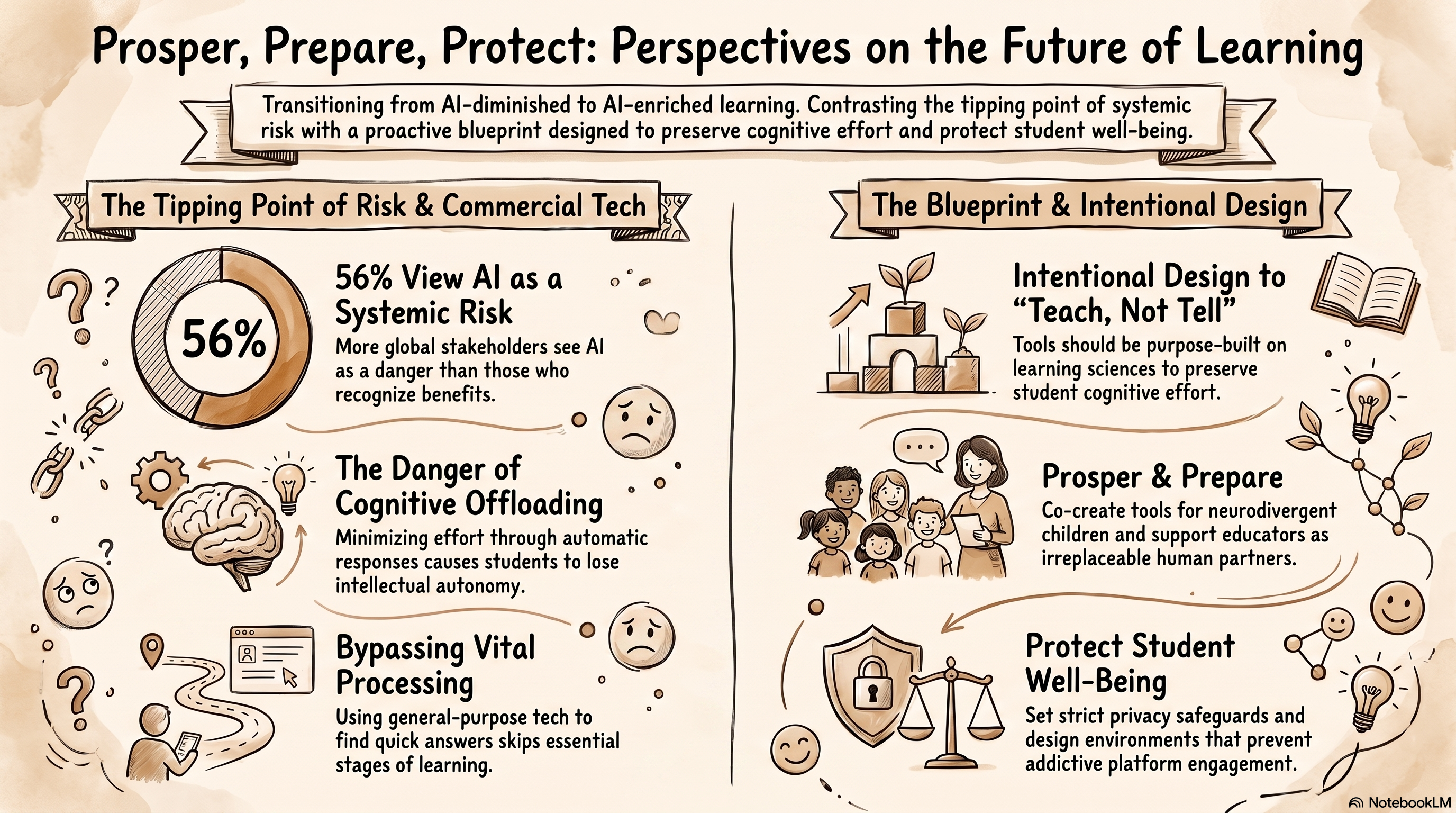
Mary’s presentation revealed an overview of the global research and mapped out how to avoid AI-diminished learningand achieve AI-enriched learning by:
Understanding the Tipping Point of Risk: 56% of global stakeholders characterise AI primarily as a systemic risk versus 44% recognising benefits. The core danger is cognitive offloading; when students use general-purpose tools to minimise effort and find automatic responses, they bypass vital processing stages and lose intellectual autonomy.
Engaging in Intentional Design: Because design matters, schools must reject general-purpose commercial tech and demand Intentional AI—software purpose-built on the learning sciences to preserve cognitive effort and teach, not tell.
Adopting The Operational Blueprint: The study outlines three mandates:
Prosper: Co-create AI learning tools alongside communities to directly extend support for neurodivergent children and ensure they are not forgotten in the co-creation of these tools.
Prepare: Promote holistic AI literacy early, training teachers to act as human partners rather than tech replacements.
Protect: Implement strict regulatory guardrails around student privacy and purposefully break platform engagement addictions to safeguard youth mental health.
AI Risks and a Blueprint for Intentional Design
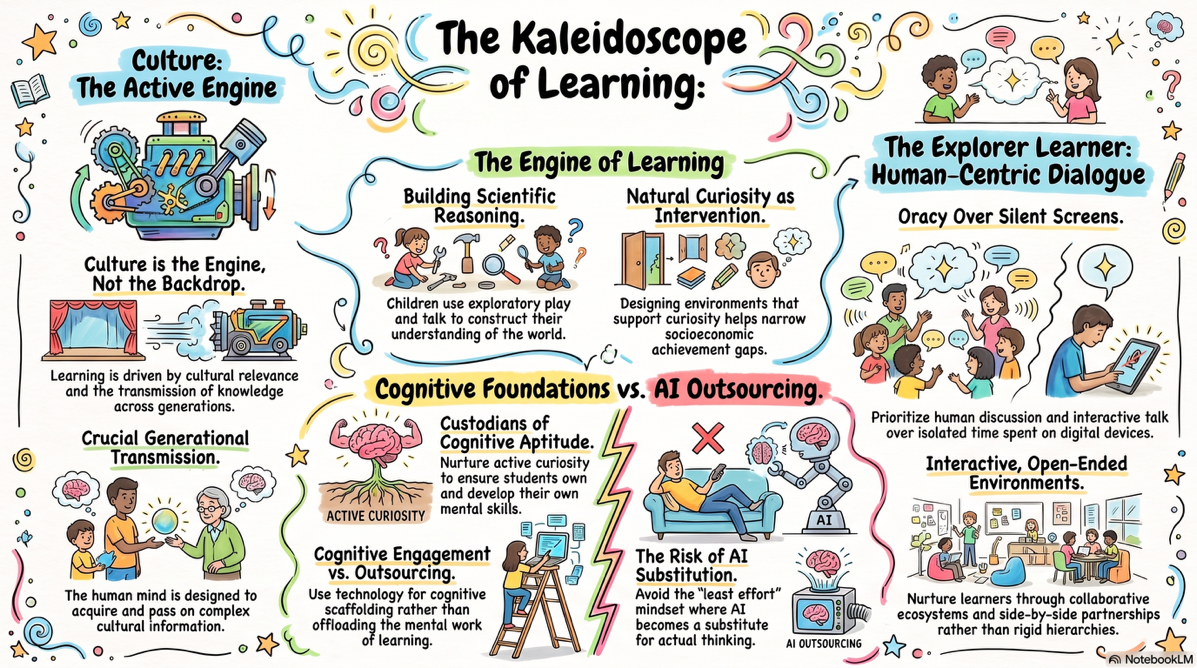
The Kaleidoscope of Learning
Cognitive Science and Cultural Relevance in the Age of AI Cristine Legare
Cristine Legare engages in deceptively simple enquiry: how the human mind learns, creates, is influenced by and transmits culture. As Professor and Director of the Center for Applied Cognitive Science at the University of Texas, Austin, her research traces this question from its roots; from the way children use exploratory play and talk to build scientific reasoning, to how communities acquire and pass on ritual, and what happens to all of that when AI enters the classroom.
Her approach brings a distinctive lens that doesn’t treat culture as a backdrop to learning, but as the engine of it. This perspective shapes Cristine’s research and teaching. Increasingly the role of AI is becoming integral to her work, including a collaboration with one of the major AI players on what it means to build educational technology that serves and optimises learning. Relying on her research and teaching experience, she seeks to ensure that the technology is designed to make students the custodians of their own cognitive aptitude, rather than invite them to offload to AI.
Crucially, Cristine warns against a lack of cultural relevance in a world dominated by AI that reflects “WEIRD” (Western, Educated, Industrialised, Rich, Democratic) biases. Amplified by the algorithms, this leads to learning inequality algorithmically induced discrimination.
Culture plays an intrinsic part in learning. Learner engagement and cognitive foundations are strongest when learning occurs in interactive, open-ended, and culturally relevant contexts that prioritise oracy and value human discussion over silent screen time.
Cristine advocates designing environments to support organic curiosity that can serve as an effective, evidence-based intervention to narrow socioeconomic achievement gaps: environments that nurture the explorer learner.
The Kaleidoscope of Learning: Culture, Dialogue and Cognitive Aptitude
Our dialogue also brought to light how her students approach their relationship with AI. Rather than encouraging exploration and cognitive engagement in the learning process and the subject, too often her students consider AI as a substitute for learning, not engaging cognitively but outsourcing their thinking to AI. What she is witnessing in her students’ behaviour is leading to a diminishing of cognitive engagement and learner agency, rather than developing both.
The discussion quickly surfaced a telling student mindset: how to get the best grades, with the least possible effort. A self-defeating attitude, though for which the blame cannot solely be placed on students. It sits increasingly at odds with what the world beyond university demands, and that is something institutions can no longer afford to ignore.
Sharing Perspectives
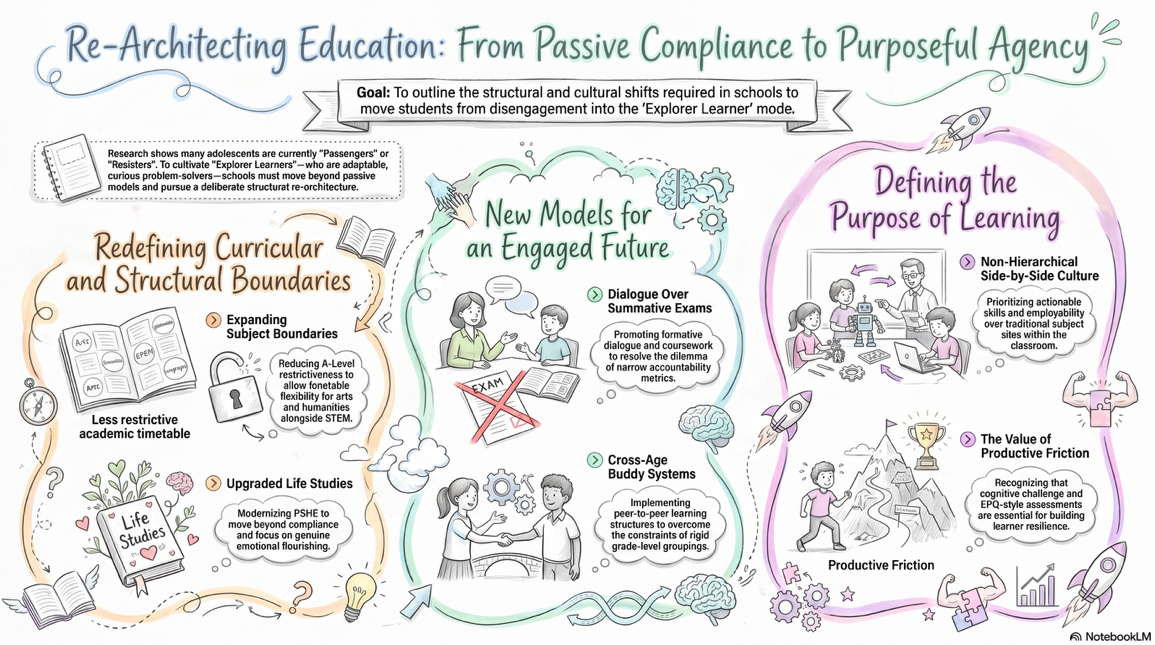
Redefining Curricular and Structural Boundaries: The Future
This section reflects the discussions and syntheses of the round-table sessions involving all conference participants and learners at North London Collegiate School.
Distinct themes came to the fore.
Redefining Curricular and Structural Boundaries
(”THE FUTURE?”)
Considering what the futures of education and learning should consider, future curriculum design and rigid barriers built into current secondary systems surfaced quickly in the dialogue that became quite UK-centric. Some key observations emerged that despite their UK focus have wider significance:
A-Level Restrictiveness & Global Alternatives: Participants, including A-Level learners, noted that choosing only three subjects at age 16 feels far too narrow. This forces major career decisions before students fully know their interests. The map suggests a more generalised, holistic model like the US system and continental Europe education systems to preserve choice.
Rethinking the Timetable: A strong call was made for systemic timetabling flexibility to allow creative, expressive subjects to run comfortably alongside heavy STEM options. As STEM is getting increased focus across curricula, the other subjects including arts, humanities, social and political studies get ignored.
Life Studies Upgrades: Reviewing essential life fluencies. The dialogue reached the conclusion that current PSHE[2] allocations in the curriculum (often a mere 35 minutes) are entirely insufficient. They advocated for built-in modules covering financial literacy, female anatomy, period awareness, gender and political current affairs.
New Models for an Engaged Future of Education
Other round table dialogue focused on shifting school infrastructure away from clinical accountability structures and toward genuine learner engagement, expressed in the key points below that may reflect UK focus, but have wider significance:
The Accountability Dilemma: The group posed a foundational design challenge: “How do we design learning around learners, not just accountability systems?” To break free from performance-driven rigidity, the model points toward a combination of student agency, robust extra-curricular options with project-based real outcomes, and interdisciplinary learning rather than siloed, isolated subjects.
Formative Dialogue vs. High-Stakes Testing: While admitting exams have a distinct place, participants argued they are critically over-emphasised. Final summative exams are flawed because they are entirely reliant on a single day’s performance. In contrast, internal formative assessments and coursework are heavily championed because they generate meaningful dialogue and teach vital workplace competencies, showing students how to iterate, adapt, change, and collaborate over time.
GCSE Constraints: General participants highlighted that while true student agency is far easier to achieve during Sixth Form when individuals pursue subjects they love, it is incredibly tricky to navigate during the rigid constraints of GCSEs. Cross-age “Buddy Systems” (peers sharing, working and learning together) were highlighted as excellent workarounds to share insights and unlock early developmental opportunities.
Re-Architecting Education for the Future and Purposeful Agency
Defining the Purpose of Learning
In an open-floor dialogue, a small group of learners and educational leaders collaborated to define how the mechanisms of schooling must shift to support an unpredictable future, translated into the following key observations:
Non-Hierarchical Classroom Culture: The notes call for “students + teachers working side by side” and operating explicitly as if they are “on the same side”. To make learning relatable, teachers must become far “more aware of student reality” rather than teaching in an academic vacuum.
Prioritising Skills over Silos: The round table urged institutions to get out of subject-based silos to encourage broader, more interdisciplinary thinking. The core framework of instruction needs a deliberate shift away from theoretical abstraction and toward actionable capability, specifically naming work-based experiences and an employability focus that emphasises leadership, self-management, and self-discipline.
The Value of Friction: Interestingly, the notes acknowledge that some academic stress is useful, stating that the “friction of exams is useful” for developing long-term character traits like resilience and time management. To evolve beyond binary grading, the map suggests rethinking rigid school schedules and introducing more EPQ[3]-style assessment.
The Learner Voice
Authentic Relational & Environmental Needs
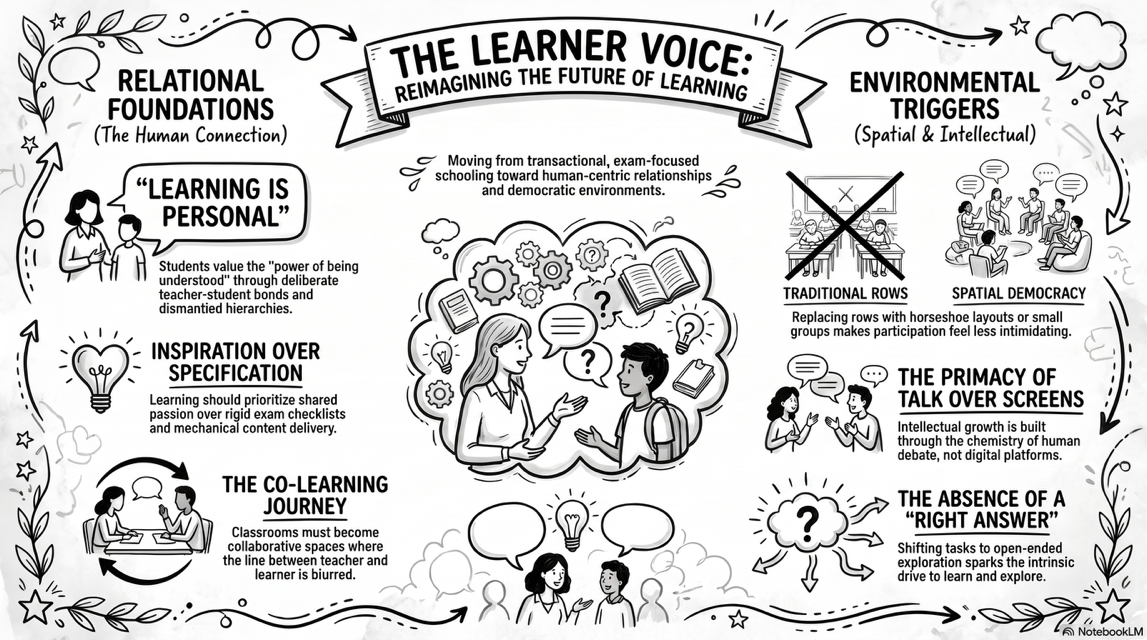
During round table dialogues and a panel discussion, learners explicitly spoke on their own terms, outlining their psychological, emotional, and spatial requirements. Distinct themes emerged.
The Human Connection: Relational Learning and Passion
Learners explored how the personal bond between educators and learners forms the true foundation of learning, arguing that the human element must become less transactional and far more collaborative as automation increases:
Learning as a Personal Journey: Students explicitly stated that “learning is personal” and cannot be reduced to mechanical delivery. They deeply value the “power of being understood,” highlighting how wonderful it is when a teacher makes a visible, deliberate effort to know them as an individual. They wish to see traditional hierarchies dismantled, treating teachers and learners as equals on a shared co-creative journey.
Inspiration Over Specification: Subjects should become “less about content” and rigid curriculum checklists. Learners argued that a teacher’s role is to present a subject beyond an exam specification, prioritising shared passion; as the students noted: “If my teacher isn’t passionate about their subject, why should I be?”
Co-Learning and Continuous Growth: The classroom must become an environment where “everyone is learning and teaching a bit,” completely blurring the line between who presents knowledge and who receives it. As students move from Year 7 up to Years 12 and 13, this dynamic must become increasingly interactive, creating a safe space that allows students to form their own opinions and interact with mutual respect.
Environmental Triggers for Maximum Engagement
Students explicitly defined the precise environmental and spatial triggers that spark their intrinsic drive to explore and learn:
The Absence of a Right Answer: Learning achieves maximum impact when tasks are open-ended, shifting the focus from rigid binary outcomes to pure exploration.
The Primacy of Talk Over Screen Time: Serving as a foundational rule for engagement, students explicitly declared that they experience “learning more about discussion than tech.” They insist that real intellectual growth is built through the chemistry of human debate and verbal exchange, asserting that digital platforms should never replace or overshadow the power of classroom conversation.
Spatial Democracy: Changing classroom layout plays a massive part in engagement. Students noted that moving from traditional straight rows to a horseshoe classroom setup makes an immediate difference; it instantly feels more democratic, collaborative, and less intimidating. Sitting in small groups, rather than in rows, with a teacher sitting alongside them completely alters their willingness to participate.
The Learner Voice: What Learners told us
Learner Structural Recommendations
To protect the Explorer Learner, learners insisted that the architecture of grading must adapt to reward connective thinking rather than isolated testing:
Silo Reconstruction: An ideal structural compromise was put forward, utilising models like the International Baccalaureate (IB) or Extended Project Qualifications (EPQ) where subjects are intellectually linked together during delivery, even if the final exams remain separate. Learners explicitly argued that simply introducing the IB as an additional alternative is not enough to satisfy diverse paths, voicing a strong desire for the autonomy to follow their own individualised, enriched programmes.
The Toolkit Elements: A proposal was made for a baseline curriculum that embeds real-world tools outside the traditional academic paradigm, specifically naming financial skills, leadership development, and emotional intelligence (EI) alongside compulsory universal themes of respect and gender awareness.
The Critique of Pure Employability: Mirroring the highest philosophical aspirations of the dialogue conveners, a bottom-line consensus emerged, warning that treating “EMPLOYABILITY as a focus for learning is Sad.”Education must pivot back to celebrating beauty, joy, curiosity, and the value of learning in its own right.
Conclusion
The second Education Futures Dialogue demonstrated that our current systems are ill aligned with the realities of an unpredictable world. By collecting data from international dialogue, education frameworks and expertise, cognitive science, public policy, and the direct voices of learners, a unified path forward emerges.
If we are to take these insights seriously, the future of education must place the Explorer Learner at its very heart. We cannot continue to treat schools as factories or learners as passive passengers on a pre-determined track, expecting them to do well in exams or high stakes standardised tests. In a world where technology can instantly generate answers, the true value of education, and learning, lies in teaching how to ask questions, navigate uncertainty, and maintain cognitive autonomy, nurturing self-regulation and agency.
By cultivating emotional safety, tearing down unnecessary hierarchies, integrating human- and learner-centric structural service design, and honouring the deeply personal relationship between teacher and learner or between peers, we can build a new educational paradigm. The box is gone. It is time to dare to imagine an educational landscape built not for compliance, but for lifelong exploration.
Thanks
Special thanks to Robin Street, Director of NLCS Innovation, my co-creator of this event and Vicky Bingham Head and the learners who engaged in our Dialogue.
This Dialogue relies on everyone in the room who make it possible and my thanks goes to: Alastair Falk, Ben Sharoni, Brenda Eisenberg, Dr Carmel Kent, Dr Cristine Legare, Fereshta Omar, Dr Hilla Tal, James Clements, Jane Mann, Jeff Lippman, Jenny Anderson, Jessica Howley, The Rt Hon Lord Knight of Weymouth (Jim), Jonathan Noakes, Kersti Worsley, Lis Tribe, Marion Smallbones, Mark Griffiths, Mary Burns, Mary Hamley, Renate Samson, Sonja Tervola, Valentina Olivieri and Yash Narain. Without you this wouldn’t happen.
Note: I have aimed to represent the Dialogue event fairly and with integrity to honour its co-creators.
Some omissions or emphasis may not reflect perceptions, opinions or proceedings in full, for which I apologise, as convener and curator.
This discussion paper has been produced with a little help from Gemini, NotebookLM and Claude to support language and consistency.
[1] Not in Education, Employment or Training
[2] Personal, Social, Health and Economic Education
[3] Extended Project Qualification
A wonderful event to host and be part of