

Introduction
Passionate about the Futures of Learning and Education, a serendipitous conversation between Robin Street, Director of Innovation at North London Collegiate School, and Carla Aerts (TrAIn Of Thought), led to a meeting with Vicky Bingham, Head of the school. Recognising that the Futures of Learning and Education are best explored in interdisciplinary dialogue, a new initiative was born.
On Friday 20th March 2026, the pilot of this initiative was launched. Twenty people, traveling from abroad and the UK, joined the launch to engage in dialogue and reflect on Learning and Education in Unexpected Places and Re-Socialising Learning. The day focused on what that means and can look like, and how we might begin to imagine new futures for both.
We welcomed Heads of schools, teachers and a professional musician, Innovation Directors, leadership experts and consultants, an entrepreneur, researchers and leaders in International Education and Education Reform, alongside experts working in STEM, publishing, system change, policy, data and, of course, AI in Education. The expertise gathered at North London Collegiate School’s Ideas Hub promised a special day. It turned out to be exactly that.
Why a Futures Dialogue?
In a world increasingly shaped by AI and standardisation, one question sits at the heart of everything we do today: how do we genuinely place learners and their teachers at the core?
Education is too often perceived through narrow frames: schools, universities, formal qualifications. Yet learning happens everywhere. Research, policy, practice, EdTech and AI tend to evolve in isolation, rarely in genuine dialogue with one another.
Today’s students and learners face a world that resists certainty and prediction. This forces harder questions: how do we nurture wellbeing and human values at the very moment intelligence itself is being redefined? How do we prepare young people for futures we can’t yet see?
The Education Futures Dialogue seeks to break down those silos. Learning and teaching take on many guises, in many places. Often, the best learning happens where it’s least expected. Yet we persist with systems that prioritise measurement over curiosity, benchmarking over aspiration, standardisation over the individual. In doing so, the essential social fabric of learning is too often eroded.
This dialogue is an invitation to rethink that. Not to discard what works, but to dare imagine a new paradigm: one that puts the learner and their teacher back at the centre, that takes learning beyond the classroom walls and prepares all of us for a future that is uncertain, technology-driven and full of possibility.
The box is gone. Time to start imagining, in dialogue.
Framing the Dialogue
Living in an AI revolution, it would have been the obvious choice to make AI the central theme for the day. We opted against it. Learning and Education go well beyond the classrooms and settings so often associated with them; yet we don’t necessarily give those other settings adequate attention. It is often there that the seeds for the Futures of Learning and Education are already germinating and flourishing. Making AI the central theme would prevent us observing those seeds.
Our day of dialogue revealed some of these seeds, often hidden gems of Learning in Unexpected Places that have significant impact on learners, teachers and wider communities. Programmes, projects and learning experiences beyond the classroom walls not only highlight the critical social dimension of learning; they reveal the importance of connection, of exploring the unknown in places where active, engaged and culture-relevant learning can take place to let learners flourish.
Sharing experiences throughout the day, it was also essential to bring learners themselves into the picture. We did exactly that, across two dialogue sessions during which they shared what matters to them and engaged enthusiastically with speakers and attendees.
Travel to the Canadian Arctic
Our day of dialogue opened with a trip to the Arctic. We discovered what Quarlimat, an Inuit-led summer programme for teenagers in Nunavik, does to build a brighter future for its teens and their communities. The programme was initiated by the Inuit community and Maggie McDonnell, the Canadian Global Teacher Prize winner in 2017, who has lived and worked closely with youth and elders in Inuit communities in the Canadian Arctic.
When you go running by yourself, you go fast.
But when you run with others, you can go so far.
Maggie McDonnell
Built on cultural activities, the programme creates safe spaces that nurture connections with Inuit role models, elders and community leaders. Hunters take the young people out onto the land to share traditional experiences and keep knowledge alive. The teenagers learn, share, socialise and connect in a culture-relevant context. They rediscover a connection with their land, communities and culture that, for many, had been lost.
A poignant example of learning happening in unexpected places: beyond the curriculum, in a deeply social, culture-inspired setting. The tone for the day was set.
The Highly Valued Currency of Education: Learning in Displaced, Disadvantaged and Refugee Contexts
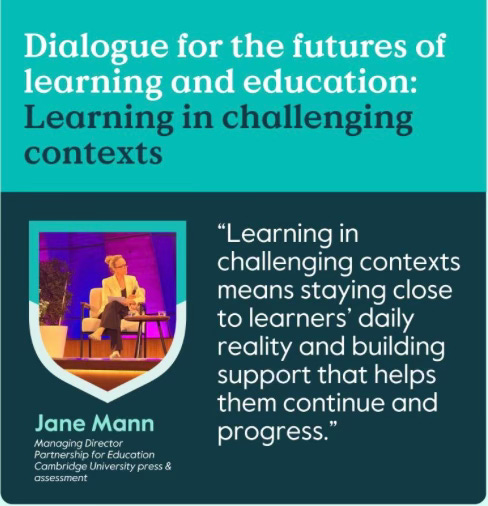
Jane Mann, Director of the Cambridge Partnership for Education, illustrated the work the Partnership has undertaken in contexts of hardship, oppression and displacement. In a fireside conversation, she described how vital education becomes to people in these circumstances, how parents in refugee camps aspire for their children to find a way out, how they want their daughters educated in regimes that actively prevent it, and how evidence of learning and achievement becomes, in Jane’s words, “highly valued currency”.
Whether moving to the next stage of a learning journey or seeking a future beyond a Syrian refugee camp in Lebanon or Cox’s Bazar, where learning often happens for just a few hours a day in makeshift learning centres, that evidence matters enormously. The importance of the portability of this currency cannot be underestimated. It can offer a way out.
For girls in countries where schooling is forbidden, learning often must happen within the secrecy of the home, confined to the inside with little or no exposure to the outside world.
In these contexts of displacement, upheaval or restriction, demonstrating progress demands forms of assessment that meet the specific needs of learners and teachers. Jane described how bespoke wall charts, showing “I can…” statements, do more than record progress: they drive motivation, instil confidence and spark curiosity. Not only in the children, but in their parents too. They provide evidence that brings a sense of achievement, hope and at times can open doors.
“Learning and challenging contexts means staying close
to learners’ daily reality and building support that
helps them continue and progress.”
Jane Mann
A highly valued currency that goes far beyond opportunity. One that builds a genuine sense of achievement and the belief that learning is possible, wherever you are.
Teaching Musicians and Breaking Bach
Lisa Beznosiuk, renowned baroque flautist, has made recordings across Europe and played in major UK and European orchestras. She is a founder and Principal Flute of the Orchestra of the Age of Enlightenment.
Lisa has been teaching the baroque flute for around forty years, and many of her students are accomplished professional musicians, playing in orchestras, chamber ensembles and enjoy successful careers as soloists.
After a short introduction to the baroque flute, she discussed her teaching practice and how her students have embraced the online world for research, sourcing scores and exploring examples of baroque playing. Her teaching is highly personalised, predominantly in one-to-one settings, whether at renowned music conservatoires or in public masterclasses, a format she finds less conducive to deep teaching and learning.
What surprised many in the room, particularly the educators, was this:
“Of course, one teaches these students to teach themselves.” Her students become the self-reflective, self-directing explorers of their craft.
The Orchestra of the Age of Enlightenment rehearses at Acland Burghley, a London secondary school. Serendipitous encounters between learners and the orchestra happen naturally. They occasionally grow into something more: a programme that takes students enthused by hip hop and breakdance all the way to the Edinburgh Festival, performing Breaking Bach, dancing to baroque music.
We were fortunate to witness the surprise, bemusement, joy and achievement of these learners in a beautiful video[1] . (Video link in footnote.)
“Teaching students is to get them to teach themselves.”
Lisa Beznosiuk
The Magic of Green Playgrounds:
Klimaat Speelplaats
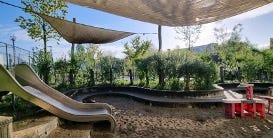
St Paulus School in Kortrijk, Belgium is a small primary school that only had a concrete playground. The children didn’t play. They stood around the edges, engaged in bullying behaviour and rarely connected with each other.
The school decided to act. The teachers acted and conceived t he idea of a Klimaat Speelplaats, a climate playground. With no budget and no government support, they pressed ahead, designing the new space with a specialist bureau and, critically, with the learners themselves at the heart of the process.
Cedric Rykaert, one of the teachers and instrumental to the project shared how a hostile, featureless expanse that disengaged the children, turned into a green environment of nooks and crannies, secret corners, space for chickens, vegetable gardening, and room to explore. Open to the community at weekends, it is rarely empty.
The children’s behaviour changed radically. Bullying stopped. The space became a place for learning as well as for living. Standing at the edges turned into engagement, with the environment, with each other, with ideas.
St Paulus has since become a reference point for playground transformation across Belgium and beyond. Cedric and his colleagues are frequently invited to advise other schools undertaking similar projects. And yes, the initiative has caught the attention of the Flemish and Belgian governments.
MyMachine:
The Invention and Building of a Dream Machine
MyMachine[2] is a global foundation built on an inter-generational collaboration model. Founded in Belgium, its methodology brings together three groups across one academic year: primary school children invent their dream machine with a sense of anything goes; university students design the concept; vocational secondary learners build a working prototype.
What makes MyMachine powerful goes well beyond skills development. Its ambition is to restore creative confidence, the kind of confidence that education systems too often erode by discouraging children from expressing their ideas and expressing their imagination. By bringing those ideas to life in unexpected, collaborative and hard-working spaces, it gives learners at every level something rare: a reason to believe their ideas and contribution matter. (Video link in footnote).
The Power of Peer-Learning: ZNotes
Zubair Junjunia, entrepreneur and founder of ZNotes, joined us from Saudi Arabia and shared the story behind the global peer-learning platform he conceived and founded.
Growing up in Jeddah, Zubair and a group of friends found that their schooling wasn’t taking them as deep into mathematics as they wanted to go. So, they started teaching each other. That experience sparked an idea: a platform where learners could solve problems and learn through their peers’ explanations and tuition.
ZNotes has grown into a free, globally accessible platform used by over six million learners worldwide, offering high-quality resources and active communities. What makes it genuinely distinctive is its ethos: a youth-led global movement that empowers young people to drive social change while building the skills and experiences that open doors to higher education and future careers.
The Dialogue: What the Room Revealed
The culmination of the day was the dialogue itself. Two roundtable discussions in small groups brought together attendees and learners from the school. The themes were Learning in Unexpected Places, places in the widest possible sense, and Re-Socialising Learning, the growing need to restore the social dimension of education in the face of its increasing individualisation. What follows is a synthesis of those conversations.
Learning in Unexpected Places
One of the first things this dialogue embarked on was quietly reframing the theme itself. The most interesting question, it turned out, wasn’t about unexpected places at all, it was about unplanned moments. Learners highlighted that places, in many cases, are not so surprising: a sports field, a drama rehearsal, a faith community, the street you run along in the morning.
What makes the learning happen is the moment of encounter within them, the thing that can’t be designed or scheduled. That recognition shifted something in the conversation in one of the round tables.
Examples came quickly and from every corner. Running a familiar city route, observing the street, navigating weather, watching interactions emerged as a rich account of learning through physical action, where the body processes what the mind has absorbed during the day. Team sport offers something different again: not just skills and fitness, but lessons in mutual support, in playing to other people’s strengths and, crucially, in losing.
One of the Heads noted that watching pupils work with each other in sport, especially when a team loses, taught them more about human resilience than almost anything else they’d witnessed in a professional context. Being a Brownie and earning badges; the social negotiations of a children’s birthday party; learning advocacy and political argument through agitprop theatre; finding culture and community in a church, mosque or synagogue aren’t just peripheral sites of learning. For many young people, they are where the most formative learning happens.
The learners in the room offered some of the sharpest contributions. One noted, with a directness that stayed with people: “Not being the best, but something to strive for.” It is the kind of honest observation that adults in formal education settings rarely feel licensed to say out loud. The youngsters’ honesty, several participants remarked, teaches us a great deal. Learning to be honest with yourself, realistic, but aspirational, turns out to be one of the harder things expected from education.
Drama, podcasts, interviews, and the simple act of really listening, these were named as sites of genuine learning. Listening is learning, one contribution read. Another: all learning comes from the unexpected. Nobody’s path is the same, and education that pretends otherwise does learners a disservice.
The conversation turned, as it inevitably does, to assessment. Here the room was unambiguous, and a little restless. Assessment, it was agreed, sits at the core of curriculum design and shapes everything downstream of it. But the current obsession with metrics leaves little room to breathe. It creates what one participant described as a system that conditions learners to be fearful. Qualifications, in their current narrow form, cannot capture the learning that happens in the places this dialogue had spent the day exploring. The Extended Project Qualification was offered as one existing tool for beginning to address this; its breadth of study at least points towards what a richer record might look like.
There was also a clear call for portability: qualifications that travel with displaced learners, that hold value across systems and borders.
And a student voice raised what may be the most urgent equity question of all: the gap in access to enrichment. The unexpected and unplanned learning experiences that were celebrated throughout the day may, in practice, be more available to some learners than others. Yet, the day clearly highlighted experiences in disadvantaged contexts and communities or inter-generational learning experiences that are available in regions where resources may be restricted, but imagination and attitudes to innovation flourish.
How do we capture those experiences when they happen? And how do we ensure they aren’t the exclusive province of those who already have the most, but also provide opportunity to those who have the least?
Education’s intent, someone offered simply, should be to improve lives. That framing, immediate, profoundly humane and almost embarrassingly obvious, cut through the rest.
Re-Socialising Learning
The second dialogue session opened with a concern that had been present all day but hadn’t yet been named plainly: that as education leans ever further into personalised, data-driven, technology-enabled models, it risks producing something socially thin.
Self-paced learning, left to itself, can induce loneliness. Data, when it is positioned above relationship, produces systems that are efficient and human at the same time in the way that most systems are — which is to say, not especially.
One participant drew a distinction that proved generative: the difference between loneliness and solitude. The act of reading is a solitary one, they observed, but it is not a lonely one. It constitutes a dialogue: with the text, with its author, with oneself. Productive solitude is worth protecting. What needs resisting is something different: a model of learning so thoroughly shaped by screens and data that the texture of human exchange, what one participant called the alive improvisation, is gradually stripped out of it.
The improvisation analogy, brought by someone who had worked in both policy and drama, revealed something important. Policy discussions, they noted, tend to run on yes, but… thus closing things down, hedging, qualifying. Improvisation, on the other hand, runs on yes, and… They build on what you hear, taking it somewhere, never apologising for where you’ve landed.
Learning, they argued, should follow the latter logic. It creates conditions for genuine exploration. It allows play. It teaches, among other things, that you can learn through not being good at something yet.
This sat alongside a harder truth: that much of what passes for learning today has been reduced to cognitive overload. We fill the time, assess the output, and call it education. But learning is fundamentally social; it happens in relationship, in dialogue and conversation, in the kind of environment where it feels safe to not know the answer. Several voices in the room converged on the importance of psychological safety: the need to create conditions in which failing is not just tolerated but recognised as part of the process in which fragility is not frowned upon. The commitment that emerged clearly from the discussion: we are teaching people, not just subjects.
The long view of education asks different questions, not only what a student knows, but how they have changed. Feedback sessions with parents, one participant suggested, might usefully include questions like: has your child become a better listener? A better friend? Some in the room noted, with interest, that tools for measuring exactly this do apparently exist, though time ran out to get deeper into that conversation.
“We are teaching people, not just subjects”
Heads and Directors of Innovation in Dialogue
Teachers featured prominently in this conversation, and not always comfortably. The role of the teacher is evolving, towards something closer to an orchestrator: someone holding a space for communal knowledge while simultaneously supporting highly individual learning paths: a steward. That is a genuinely demanding task. And it is being asked of a profession that is, in the room’s own word, frazzled. The pressure of differentiation, the weight of administrative expectation, the pace of change are not background conditions. They are the daily reality in which teachers are being asked to innovate, to personalise, to support good grades and achievement, and to re-humanise learning all at once.
One thread that deserves more attention than it received: at what point in a teacher’s professional development should new tools including AI, be introduced, without disrupting foundations still being formed? The question of timing and sequencing in teacher education and professional development is not merely logistical. Get it wrong and you create dependency or confusion at exactly the stage when a teacher most needs to develop her own instincts.
The roundtable also surfaced a false hierarchy that is doing real damage: the pervasive assumption that academic and vocational knowledge occupy different rungs of a ladder, with the former sitting above the latter. The Belgium example offered was stark though not unique: a country awash with overqualified master graduates whilst facing a serious shortage of plumbers. False hierarchies have consequences. Education systems that perpetuate them are not preparing learners for the world as it is, never mind what it will be.
The conversations in this roundtable ended, as good dialogues do, without resolution but with a shared direction. Togetherness and collaboration are not soft values or nice-to-haves. They are conditions of learning. Re-socialising education is not a reaction against technology; it is a commitment to ensuring that whatever role technology plays, it does not displace the human encounter at the centre of any serious act of learning.
What next?
The Education Futures Dialogue is not a one-day event. It is, as the name suggests, an ongoing conversation, one that is necessary because the questions are real, the stakes are high, and the distance between research, policy, practice and the learner remains costly.
What the day made clear is that the answers won’t come from any single sector, discipline or institution. They will emerge, as the best learning does, in unexpected places, through genuine encounter, and in dialogue.
The box is gone. The dialogue has started.
The end of a day of dialogue!
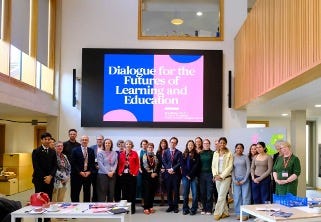
Huge thanks to Robin Street, Director of Innovation at NLCS, Vicky Bingham Head and all those enriching the dialogue during the day.
Mary Hamley (OUP), Laura Giddings (Rivers and Canal Trust), Zubair Junjunia (ZNotes), Cedric Rykaert (St Paulus School Kortrijk, Belgium), Safia Tmiri (Expert in AI and Education), Sally-Anne Huang (High Master of St Paul’s), Jane Mann (Cambridge Partnership for Education), Renate Samson (Digital, Data and AI Policy Specialist), Lisa Beznosiuk (Flute Teacher, Orchestral Player and Principal Flute - Orchestra of the Age of Enlightenment), Rebecca Warren (School of System Change), Alastair Falk (Education Consultant & Tsitsi Fringe Festival), Anna Paul (Head, South Hampstead High School), Brenda Eisenberg (Insight and Strategy Consultant), Estelle Linjun Wu (PhD student), Kate Howell (HMC - Headmasters and Headmistress Conference), Will Van Reyck (Director of Innovation, St Paul’s), Marion Smallbones (Education Development Trust)
[1] Does hip hop dance work with Baroque Music? The story of Breaking Bach.
[2] My Machine was founded in Belgium
https://mymachine-global.org